Print on demand sits in an odd spot in the ecommerce world. It gets pitched as the lowest-risk way to sell physical products online, and in one narrow sense that is true. But “low risk” is not the same as “easy money,” and the model has real trade-offs that determine whether it fits your goals. This guide walks through how print on demand actually works, where the money goes, and the type of seller it tends to reward.
What Print on Demand Actually Is
Print on demand (POD) is a fulfillment method where a product is manufactured only after a customer places an order. You upload a design to a supplier, list the resulting product in your store, and when someone buys it, the supplier prints your design onto a blank item, packs it, and ships it directly to the customer. You never touch the physical goods.
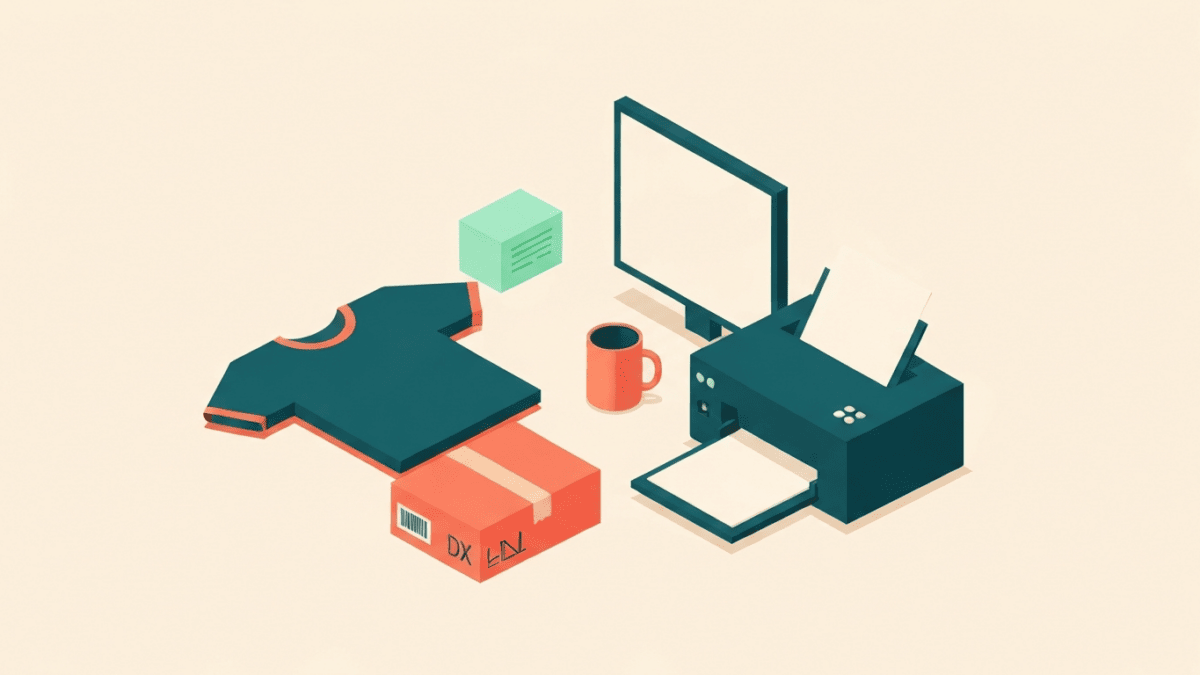
The classic POD catalog is apparel and accessories: t-shirts, hoodies, mugs, tote bags, phone cases, posters, and stickers. The common thread is that these are blank “base” products that can be decorated with a printed graphic. Your contribution is the artwork and the storefront; the supplier owns the printing equipment, the blank inventory, and the shipping logistics.
Because production happens per order, you are not buying stock up front. That single fact is what makes POD structurally different from most other retail models, and it drives nearly every advantage and limitation that follows.
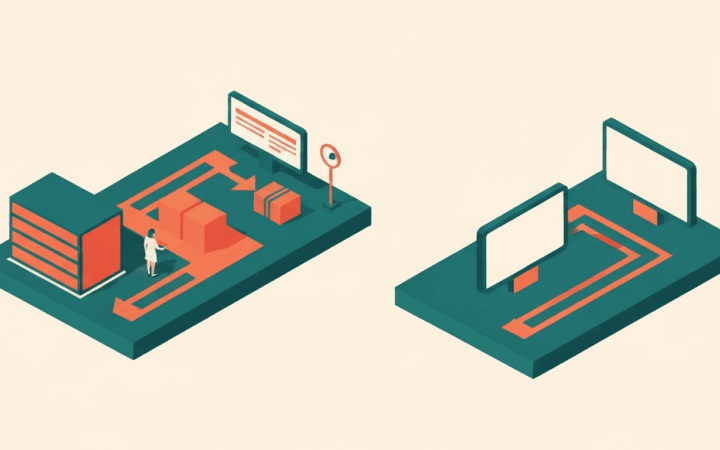
How the Order Flow Works, Step by Step
It helps to see the full loop, because the mechanics explain where your responsibilities begin and end.
- You create a design. This is a digital graphic sized to the supplier’s print specifications.
- You connect a POD supplier to a storefront. Most sellers use a supplier that integrates with a platform such as a hosted store builder or an online marketplace.
- You publish product listings. The supplier generates mockups of your design on their blank products, and you set your retail price.
- A customer orders. The sale happens in your store; the customer pays your retail price.
- The supplier produces and ships. The order routes to the supplier, who charges you their base cost plus shipping, prints the item, and sends it to the buyer.
- You keep the difference. Your margin is your retail price minus the supplier’s base cost, shipping, and any platform or payment fees.
The key detail is that you are paid by the customer and separately billed by the supplier. You are effectively a middle layer that sets prices and controls branding, while outsourcing everything physical.
Where the Economics Really Sit
This is the part most introductions gloss over. POD removes inventory risk, but it does so by giving up the biggest lever in physical products: economies of scale. When you buy blank goods in bulk and decorate them yourself, your per-unit cost falls as volume rises. With POD, you pay a per-item production cost on every single order, no matter how many you sell. You are renting the supplier’s capacity rather than owning it.
The practical consequence is that POD margins tend to be thinner than bulk-inventory margins on the same category of product. You are paying for convenience and for the elimination of upfront cost, and that convenience has a price baked into every unit. Whether the remaining margin is workable depends heavily on your niche, your design’s perceived value, and how efficiently you acquire customers.
Customer acquisition is where POD businesses usually live or die. Because the product itself is a commodity blank that many other sellers can also offer, the differentiation is the design, the brand, and the audience you reach. If you have to pay for every visitor through advertising and your margin per sale is slim, the math can get tight quickly. If you already have an audience or a distinctive design point of view, the same margin can be perfectly viable.
A Simple Way to Sanity-Check the Margin
Before listing anything, work the numbers backwards. Start from a retail price you believe the market will accept, subtract the supplier’s base cost and shipping, subtract platform and payment processing fees, and only then look at what is left. That leftover figure is what has to cover marketing, returns, and your own time. If it does not survive that subtraction, no amount of volume fixes it.
The Honest Advantages
POD earns its reputation on a few genuine strengths:
- Low upfront capital. You are not committing money to inventory that might not sell. Your main investment is design work and store setup.
- No dead stock. Because items are made to order, you never end up sitting on unsold boxes. A design that flops simply stops selling; it does not become a loss you have to liquidate.
- Wide catalog experimentation. You can test many designs and product types cheaply, since adding a listing costs effort rather than inventory dollars.
- Location independence and light operations. With no warehousing or packing on your end, the operation can run lean.
These advantages are real and worth taking seriously. They make POD a reasonable way to test whether a design or niche has demand before committing to anything heavier.
The Honest Limitations
The same design choices that reduce risk also cap the upside and hand away control:
- Thinner margins. As covered above, per-order production costs erode the profit that bulk buyers keep.
- Limited quality and product control. The blank base, print method, and packing are the supplier’s. If quality slips, your brand takes the complaint but you cannot directly fix the process.
- Longer and less predictable fulfillment. Made-to-order production adds time before an item even ships, which can clash with the fast-shipping expectations customers now carry.
- Commoditized products. Competitors can offer the same blanks. Your defensibility lives almost entirely in design, brand, and audience.
- Dependency on the supplier. Price changes, stock issues, or service problems on their end flow straight through to your business.
Who Print on Demand Is Actually For
POD fits best when the model’s strengths line up with what you already have. It tends to suit:
- Creators and designers with an audience. If you already reach people through a following, a community, or a content channel, POD lets you offer branded merchandise without operational overhead, and your acquisition cost is effectively lower because the audience is already there.
- Sellers testing demand. If you want to learn whether a niche or design resonates before investing in bulk inventory, POD is a low-cost probe.
- Niche and design-led brands. Where the value is in the artwork or the point of view rather than the physical item, POD’s commodity blanks matter less.
It fits poorly when you are hoping for large per-unit margins, when your product needs tight quality control, or when your plan depends entirely on paid advertising with a thin margin to absorb the cost. In those cases, the structural economics work against you no matter how good the execution is.
Getting Started Without Overcommitting
If POD suits your situation, the sensible path is to start small and let real orders teach you. Pick a narrow niche where you understand the audience, create a handful of designs rather than flooding a catalog, and order samples of your own products so you can judge the quality your customers will receive. Treat the first months as learning rather than scaling, and pay attention to your true per-order margin after every fee. POD rewards patience and design judgment far more than it rewards volume for its own sake.